
Introducing Reiterate OS: AI-powered operating system for finance teams
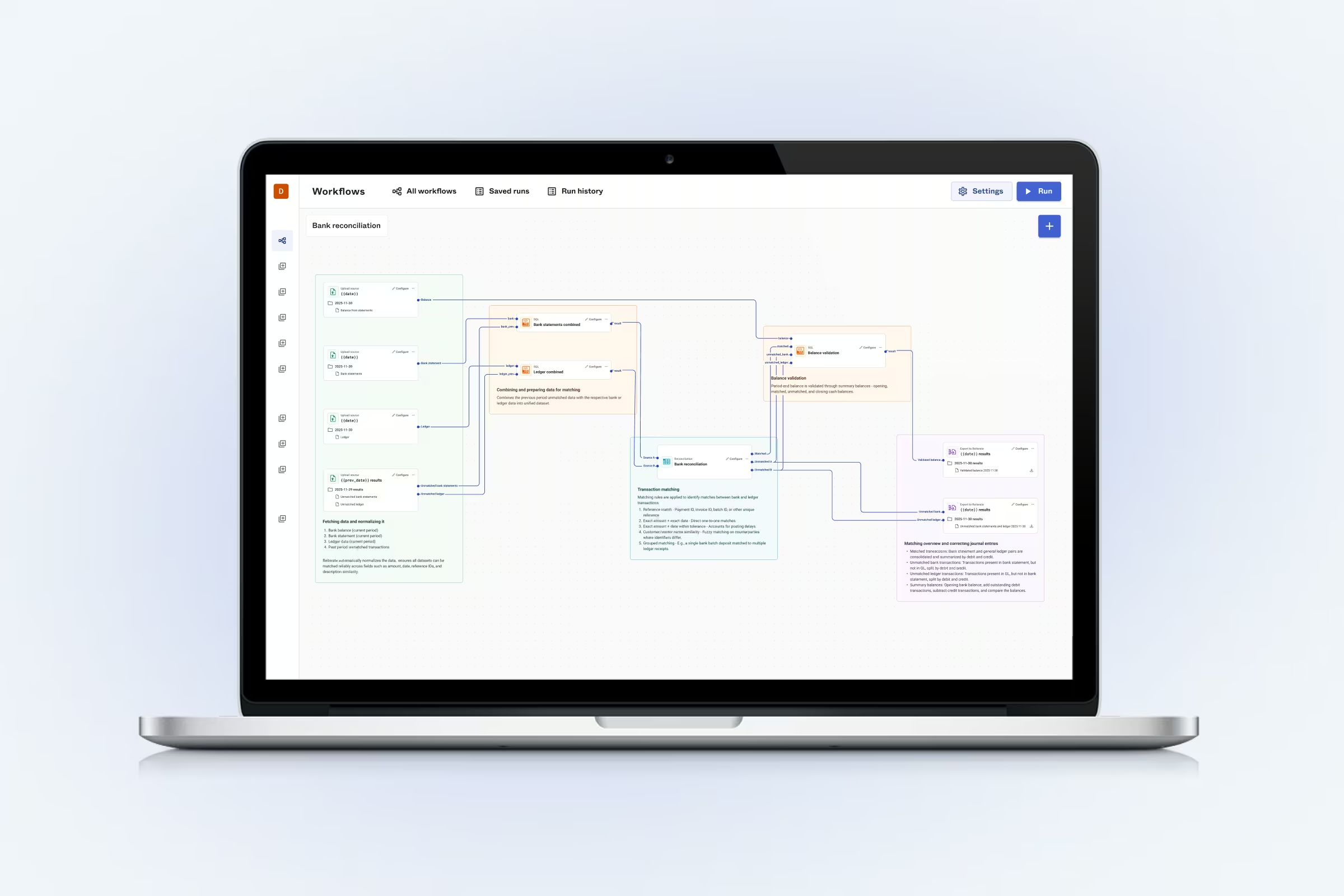
Table of contents
Subscribe to our newsletter
Stay ahead with industry news, expert tips, and innovative strategies to enhance your financial operations.
Finance teams are stuck between two worlds. The world where Excel has been their Swiss Army knife for decades. And one where modern operations demand automated data orchestration across dozens of data sources, all at a scale that spreadsheets were never designed to handle.
This has led finance teams to operate with extensive Excel files that have become their core operational infrastructure. These spreadsheets consolidate data from their entire technology stack, including ERPs, payment processors, and banks. But maintaining this setup requires constant manual work, exporting CSVs, copying data between platforms, and validating calculations daily.
The result? Teams become entangled in manual oversight, small errors accumulate over time, and strategic financial work gets pushed aside for operational emergencies.
But it's not the finance team's fault. For 40 years, Excel has been their only option. The problem is that those spreadsheets have evolved from analysis tools into untraceable production systems running mission-critical workflows.
Finance teams don't need another tool that promises to replace spreadsheets. They need an operational layer that preserves what makes Excel trusted – transparency, auditability, and control – while evolving with the demands of modern finance operations.
Say hello to Reiterate OS
Reiterate OS is an AI-powered operating system for finance teams. It sits across your existing tools and files, and continuously runs finance workflows based on your processes and rules.
"At Reiterate, we originally set out to automate reconciliation and financial controls. And it worked, saving teams hours of manual effort. But as we worked with more CFOs and finance operations teams, a bigger pattern emerged. Finance teams were forced to manually orchestrate fragmented datasets not just for reconciliation, but across all core financial processes, from reporting and analysis to month-end close and strategic planning.” - Joonatan Samuel, Reiterate’s CEO.
Reiterate OS turns manual, repetitive financial processes like data collection, core accounting operations, financial close, and FP&A into automated workflows. Unlike traditional RPA or AI-automation tools, it’s designed to handle large amounts of data, prioritizing modularity, accuracy, and auditability at its core.
One of Reiterate OS early adopters – Admiral Markets, an international trading and investment platform – uses Reiterate OS as a centralized process hub for daily finance operations. They run dozens of automated workflows every day, covering the full daily close lifecycle from stock trade processing to balance checks across banks and PSPs. Following the initial implementation, Admiral Markets continues to expand Reiterate OS across entities and use cases to support core finance operations and informed decision-making.
Using AI without compromising financial accuracy
We spoke with dozens of finance professionals, and a quote from Lightyear’s Head of Finance, Uku Lember, summed it up well: "I wouldn't trust any numbers coming out of an AI system. 99% probability is not good enough for me. I need to know how the result was derived.”
Reiterate OS takes a different approach to AI. Instead of letting AI directly process your financial data and risking accuracy errors, we use large language models (LLMs) to gather data, understand your processes, and generate workflow configurations. Once you review and approve these workflows, they run deterministically, based on your business logic and produce reliable results every time.
This means you get the speed and intelligence of AI in data integration and workflow design, combined with the precision and auditability finance teams require. Every calculation is traceable, all changes are logged, and each output can be verified back to its source.
What’s next?
We continue developing Reiterate OS by giving more power to our end users. The next step is opening access to the AI agent that sets up workflows automatically. After extensive testing by internal teams, the agent is now ready for broader use. Instead of manually configuring each workflow, requirements can be described in plain language, and the agent will generate a complete workflow configuration that can be reviewed and deployed.
In the meantime, you can book a demo to see the product up close and subscribe to our newsletter, where we’ll share interesting use cases every week.